
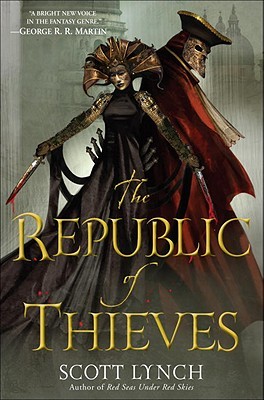
The Republic of Thieves
Gentleman Bastard #3
Scott Lynch
October 8th, 2013
Del Rey
650 pages
Amazon/Book Depository/B&N

Arc was acquired by Netgalley for an honest review.
Book was read out loud to husband.
With what should have been the greatest heist of their career gone spectacularly sour, Locke and his trusted partner, Jean, have barely escaped with their lives. Or at least Jean has. But Locke is slowly succumbing to a deadly poison that no alchemist or physiker can cure. Yet just as the end is near, a mysterious Bondsmage offers Locke an opportunity that will either save him or finish him off once and for all.
Magi political elections are imminent, and the factions are in need of a pawn. If Locke agrees to play the role, sorcery will be used to purge the venom from his body - though the process will be so excruciating he may well wish for death. Locke is opposed, but two factors cause his will to crumble: Jean's imploring - and the Bondsmage's mention of a woman from Locke's past: Sabetha. She is the love of his life, his equal in skill and wit, and now, his greatest rival.
Locke was smitten with Sabetha from his first glimpse of her as a young fellow orphan and thief-in-training. But after a tumultuous courtship, Sabetha broke away. Now they will reunite in yet another clash of wills. For faced with his one and only match in both love and trickery, Locke must choose whether to fight Sabetha - or to woo her. It is a decision on which both their lives may depend.
I don't feel like I should have to tell you guys this, seeing this is the third installment of a pretty lengthy and plot filled epic fantasy series, but this review is going to contain plenty of SPOILERS. That's right. Spoilers. Stop reading if you want to retain your delicate sensibilities. If you don't believe me, listen to River Song.

This book. This highly anticipated book. One of the books that I pined over when the publication date got pushed back. A book that I spent several minutes on the floor rolling around in glee when I received the confirmation email that I had been approved for the ARC. I had some expectations that weren't quite fulfilled, some holes that weren't adequately stuffed with satisfactory prose.
Most authors, especially those that are not new to me, I approach with expectations. I feel this is true in a sense for some TV writers as well. With George RR Martin, I expect there will be pages of food, boners, and 'making water', but I also expect there to be twists and turns and feelings and plenty of death. With Joe Abercrombie, I expect there to be plenty of loose threads that culminate in shocking and disturbing ways. With Patrick Rothfuss, I expect there to be interesting uses of magic in between banal hipster barding.
Well, you guys, with Scott Lynch, I expect there to be witty banter, amazing cons, plenty of SNAFUs and, most importantly, a foreboding feel to the air despite all the fun.
I didn't get that. I received a book that was part mooning, part political nonsense and part Shakespearean play.
The book itself opened as the other two have, with jumps back and forth in time. Only this time, the relevant information in the flashbacks was not contained to only one section of the book. It continued throughout the entire novel, effectively splitting the book into two books with their own set of circumstances, enemies, climaxes and conclusions. This proved problematic as the chapters became longer and the plots more intricate. One chapter would be devoted to present time whilst the next (fifteen subchapters later) would be devoted to the past. Thus being said, some details became lost in the shuffle. The cousin, Donker, was virtually unnoticed and forgotten about by the time he became a key player. It was this way for several characters and certain injuries (I kept forgetting that Jean broke his nose).
Sabetha is finally in this book! She'd been elevated by the author and the characters to be higher than just simply on a pedestal. She was cunning and fierce and sexy, everything the rest of the bumbling Gentlemen Bastards could use and were not. But, she was only ever spoken of in reverent sighs, bastardized by the feelings and memories of our hero. So, when she finally showed up, I was less then thrilled.

Locke's obsession with her is unnerving and completely off base for anyone who has yet to undergo the joys of puberty. I suppose this cements the mage's theory later in the book, but initially it tarnishes the romance and made me feel dirty. I will admit, before this book, I shipped Sabetha/Locke hard. After this book, I just want Locke to shut up about it. When most of the book is spent awkwardly fumbling a romance and pining over it, you get over it fast. It didn't matter what point in time the characters were, it was always the same deal. At a certain point it stops being character development and starts being tedious.
The flashbacks deal with the young Gentleman Bastards hitting the road and joining an acting troupe. There's blessedly few pieces of drama to deal with. Those that do exist all involve a Lord who becomes their patron and later becomes a corpse. They deal with it fantastically, showing me the bright eyed ploys that I'm used to seeing from Lynch's writing. It was Weekend at Bernie's with an Ocean's 11 flair. Unfortunately, this didn't happen until the last 15% of the book. But, I'm glad it finished strong.
The present arc of the book puts Locke and Jean where they were when we left them. Locke is poisoned and spending the first few chapters feeling sorry for himself (I'm sensing a pattern). Jean is spending all their money trying to find help, that is, until the bondsmagi show up.
Oh yes, the bondsmagi. While they've been a driving force and a sinister presence in the first two books, this book has them losing all their luster. In fact, they rig an election every five years and hang out and take contracts and are otherwise stuffy boring types. It completely ruined the allure.
Anyway, they use their dark craft to fix Locke. This is slightly funny to me, as they aren't healers at all. They're pretty much all destructive doom without the fixing. The mages are able to remove the poison from Locke's body. They don't heal him at all, actually. But, you know, he's not poisoned anymore. In return for doing this act, they demand that Locke and Jean come with them to Karthain and rig the election for the political party of their choice.
Turns out, that's just how they do. It's a game to the mages. The other political party has hired their own confidence man, who turns out to be Sabetha. The two opposing forces try to one up each other throughout the book and end up at a stalemate. It's not a surprise. All the flashback games that they played had them equally matched and all ended in ties. They wander off into the sunset together, friends.
Until the mages interfere again. They can't ever go away. They were in the middle of a damnable mage war and still decided to come mess with Locke's life. They tell him secrets about past a past life that make a little sense, but also doesn't make any sense. They give him a prophecy and then disappear into the night, forever.
Except for the Falconer. If you remember him, he's the bondsmagi from the first book whom Locke and Jean mutilate. He's spent three years in a coma and is utterly crippled. Or is he? Clearly someone gave him some Bioshock vigors. And so the book ends, on a cliffhanger that is only really seen in horror movies.
Considering the rolling momentum of the climax and the end, I'm still excited for this series. Unfortunately, I can't rate it higher than a three, because most of it was meandering and lacking in the usual moxie that I've come to expect. Even with the nautical lessons of the previous novel, there was still some of the usual witty dialogue and excitement. This one had very little of that until the very end. Here's hoping the two novellas retain their vim and vigor or I may have to set this series aside.


